› The Peaq 90 offers over 640 kilometres of electric range, with fast charging from 10% to 80% in 28 minutes; the Peaq 60 reaches 80% in just 27 minutes⁶
› Built on the proven Modular Electrification Toolkit (MEB+), the Peaq offers a choice of two battery capacities and three powertrain variants
› The larger 91 kWh battery has the highest capacity of any Škoda electric vehicle battery
› With a towing capacity of up to 2,000 kg, the Peaq is a versatile partner for everyday use and beyond
› One-pedal driving makes electric driving effortless in everyday traffic
› Bidirectional charging makes the Peaq a practical power source
› The next-generation heat pump increases efficiency and range
Mladá Boleslav, 21 September 2026 – The Peaq is available with two battery capacities, including a 91 kWh unit, the highest-capacity battery ever fitted to a Škoda vehicle. With the largest battery capacity in the line-up, the Peaq also offers the longest range of any all-electric Škoda model, at more than 640 kilometres. Three powertrain variants are offered, with outputs ranging from 150 kW to 220 kW⁷ and a choice of rear-wheel or all-wheel drive. A towing capacity of up to 2,000 kg further underlines the Peaq’s versatility, making it suitable even for more demanding tasks. The one-pedal driving function simplifies everyday operation, allowing drivers to accelerate and decelerate intuitively using just the accelerator pedal. Bidirectional charging turns the Peaq into a practical power source, adding clear everyday value beyond driving. A next-generation heat pump, offered as an option, further improves efficiency.
Exceptional battery capacity
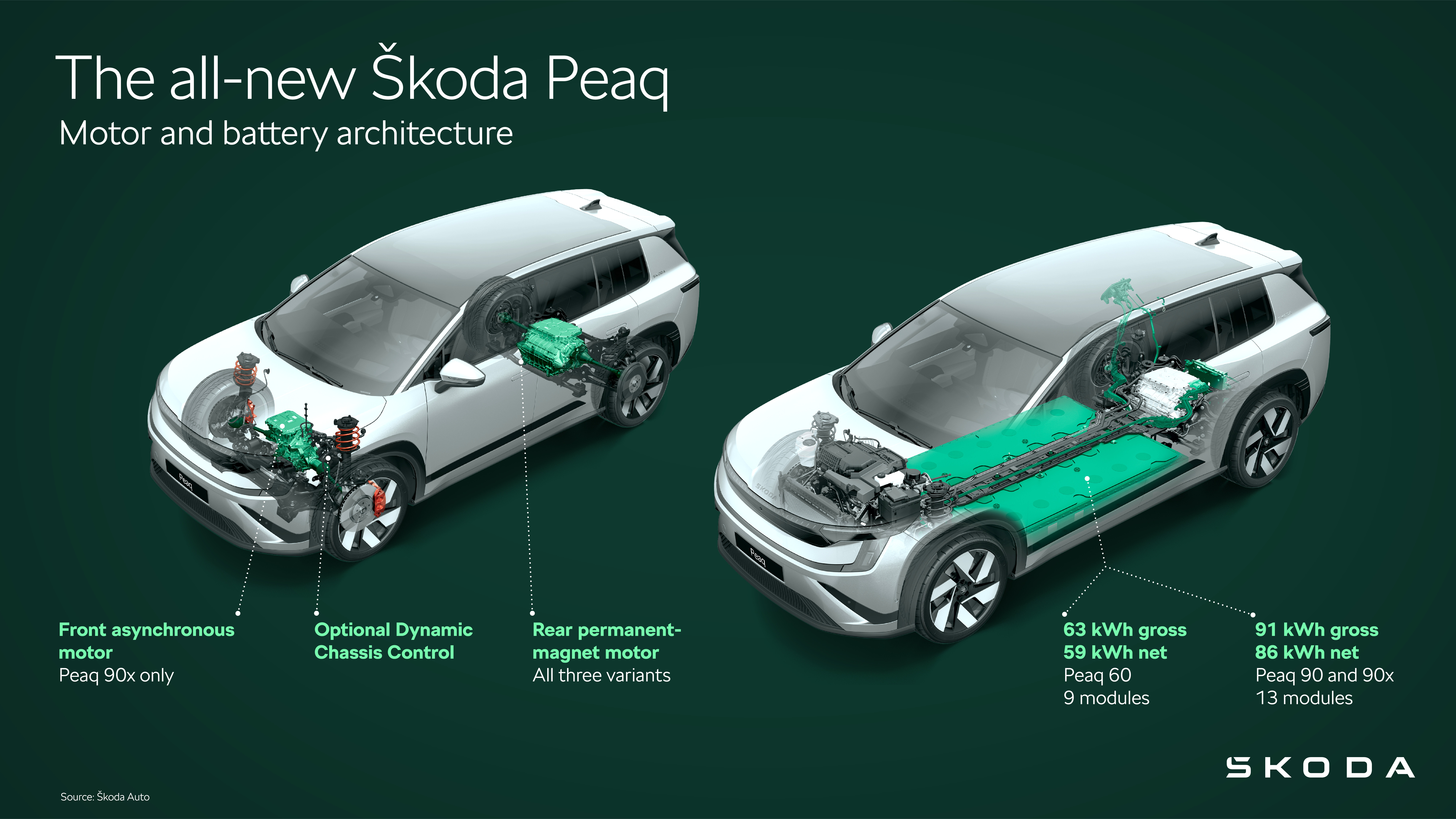
The all-new Peaq is available with two battery capacities. The smaller battery comprises nine modules, has a gross capacity of 63 kWh (59 kWh net), and can be charged from 10% to 80% in just 27 minutes⁶. The larger 13-module unit has a gross capacity of 91 kWh (86 kWh net), giving it the highest capacity of any Škoda electric vehicle battery. Charging from 10% to 80% takes just 28 minutes⁶. Both battery systems are manufactured in Mladá Boleslav and use nickel-manganese-cobalt (NMC) chemistry, providing high energy density and supporting a longer electric range.
Three power variants
The Peaq comes in three variants – the Peaq 60, Peaq 90, and Peaq 90x.
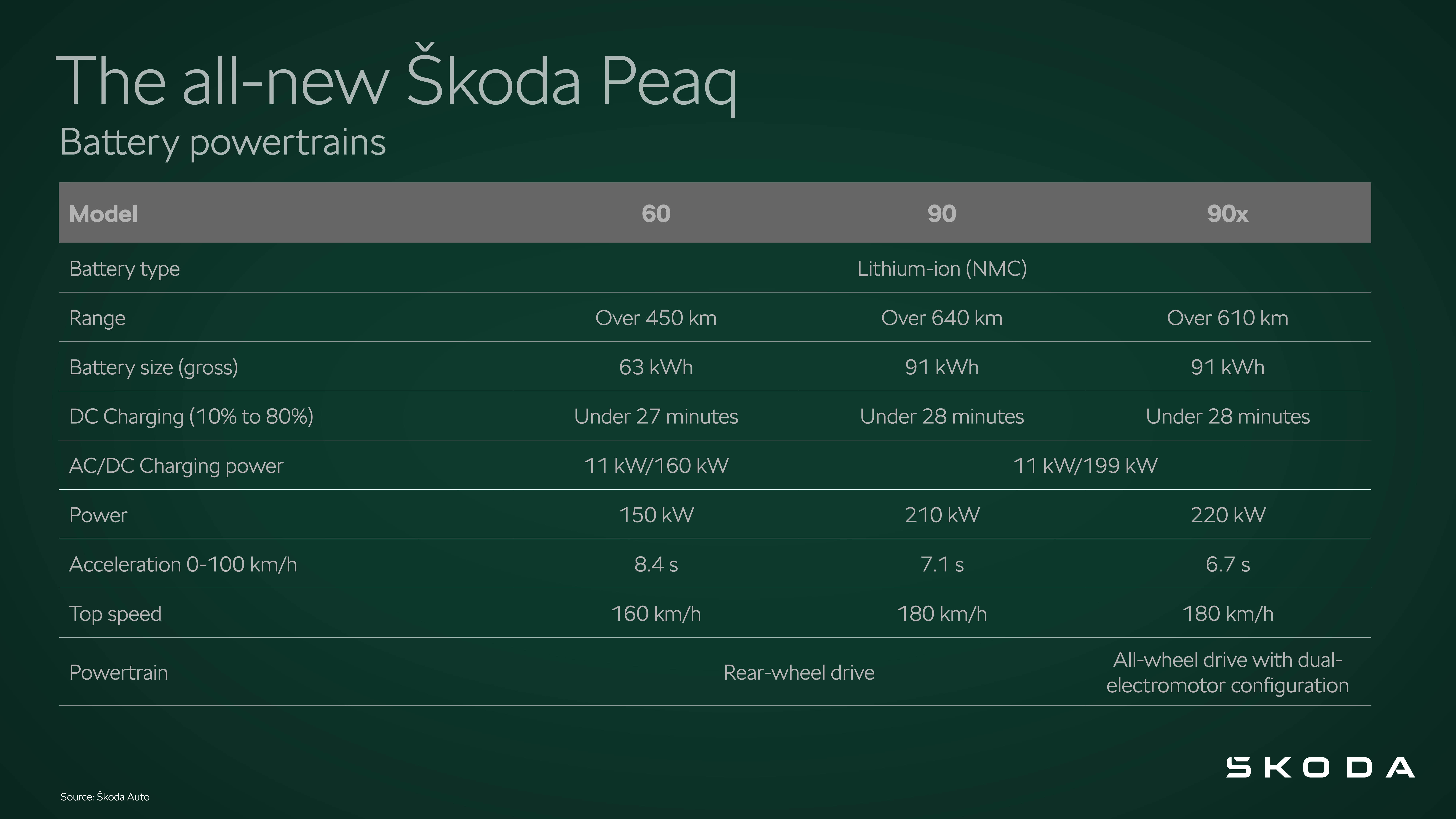
The Peaq 60 uses the smaller battery and has rear-wheel drive, with a maximum output of 150 kW⁷ and a maximum torque of 350 Nm. It accelerates from 0 to 100 km/h in 8.4 seconds, has a top speed of 160 km/h, and offers a range of over 450 kilometres on a single charge.
Both the Peaq 90 and Peaq 90x are paired with the 91 kWh battery. The Peaq 90 has rear-wheel drive, while the Peaq 90x has all-wheel drive. The Peaq 90 delivers a maximum output of 210 kW and a maximum torque of 545 Nm; the Peaq 90x delivers a maximum output of 220 kW⁷. Acceleration from 0 to 100 km/h takes 7.1 seconds and 6.7 seconds respectively. Both variants have a top speed of 180 km/h. The Peaq 90 offers a range of more than 640 kilometres, while the Peaq 90x exceeds 610 kilometres.
All three Peaq variants can optionally be equipped with a tow bar. When towing braked trailers, the Peaq 60 and 90 have a towing capacity of up to 1,800 kg, while the Peaq 90x can tow up to 2,000 kg. The unbraked limit is 750 kg across all variants.
All variants use a permanent-magnet synchronous motor on the rear axle, combining high efficiency with dynamic acceleration. On the Peaq 90x, the front axle is driven by an asynchronous electric motor characterised by short-term overload capability and low friction losses. Energy recuperation, coasting mode, and the ECO assistant further improve efficiency and, in turn, range across all variants.
Easy electric driving with one pedal
The Škoda Peaq supports one-pedal driving. Selecting B mode on the drive selector activates one-pedal driving mode, allowing the vehicle to come to a complete standstill using recuperation alone. In addition to B mode, one-pedal driving can also be activated using the steering wheel paddles, which are currently available only on the Sportline variant.
Power that works both ways
The Peaq is equipped with bidirectional charging, allowing the energy stored in its battery to be used externally. Vehicle-to-Load (V2L) can power external devices, such as e-bikes or electrical appliances, either via a 230 V socket in the luggage compartment or via a V2L adapter connected to the vehicle’s charging port.
The Peaq also supports Vehicle-to-Home (V2H), which can use energy stored in the vehicle’s battery to power a household or business, helping to optimise energy consumption, for example, by drawing on the battery during peak tariff periods and charging the vehicle when electricity is cheaper. V2H requires a compatible DC bidirectional wallbox – for the Peaq, AmbiCHARGE Home 11 kW DC by Ambibox is currently certified.
Efficiency in every season with a next-generation heat pump
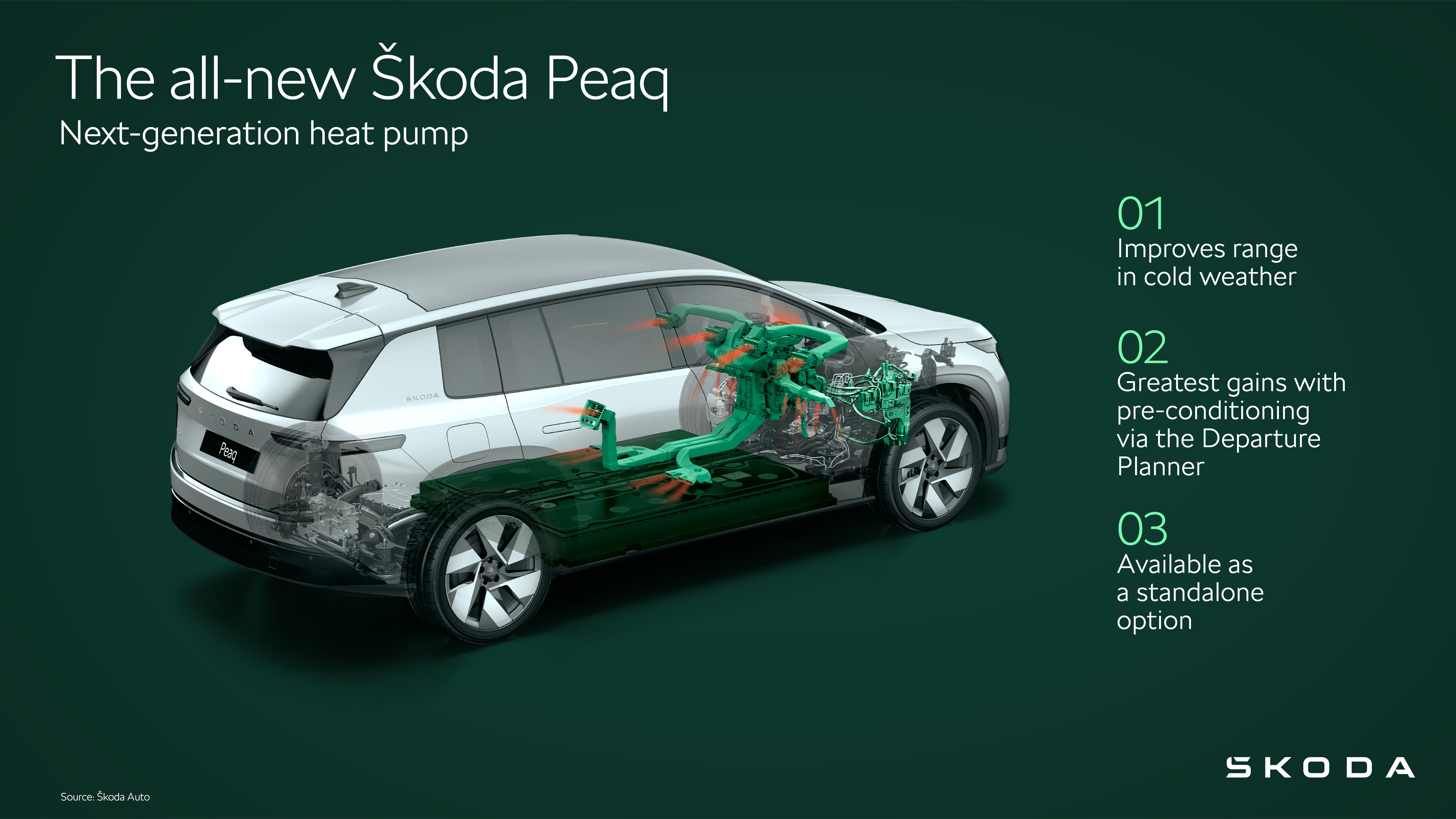
An optional next-generation heat pump is available as a standalone feature for the Peaq, improving electric range in cold weather compared with the previous system. The greatest gains are achieved when the vehicle is pre-conditioned before departure, for example, via the Departure Planner.
Brakes and suspension
The Peaq has MacPherson strut suspension with disc brakes at the front, while the rear axle uses a five-link suspension setup with reliable, low-maintenance drum brakes. Recuperation on the driven rear axle handles the vast majority of braking in everyday driving. In B mode, recuperation alone accounts for more than 95% of braking requirements.
⁶ Maximum charging power and Charging time (from 10% to 80%). The actual charging performance can vary between charging stations even at the same kW rating. It depends on factors such as maximum charging current, ambient and battery temperature, battery state of charge and ageing, as well as the condition and load of the charging station and infrastructure. The stated maximum power is measured under WLTP conditions at around 23 °C and a battery state of charge of at least five per cent. Changes in these conditions may lead to different charging performance.
⁷ The maximum power is determined in accordance with UN-GTR.21. The maximum power is available when the high-voltage battery is at its highest possible state of charge (SoC) and operating within its optimal temperature range. The power available varies according to the driving scenario and is influenced by factors including the battery’s temperature, SoC, and physical ageing.
 |
Explore the new ‘What’s up, Škoda?’ channel: go.skoda.eu/whatsapp |


Vítězslav Kodym
Head of Product Communications
+420 604 292 131
vitezslav.kodym@skoda-auto.cz
Zbyněk Straškraba
Spokesperson Product Communications
+420 605 293 168
zbynek.straskraba@skoda-auto.cz