› The Epiq is the first front-wheel-drive Škoda model based on the new MEB+ electric platform
› Full one-pedal driving in B mode, with adjustable regeneration intensity
› Front-wheel drive and smaller, lighter traction batteries for a more spacious interior and lower energy consumption
› Three power variants and two traction battery capacities
› A range of up to 440 kilometres and fast DC charging from 10% to 80% in 23 minutes⁴
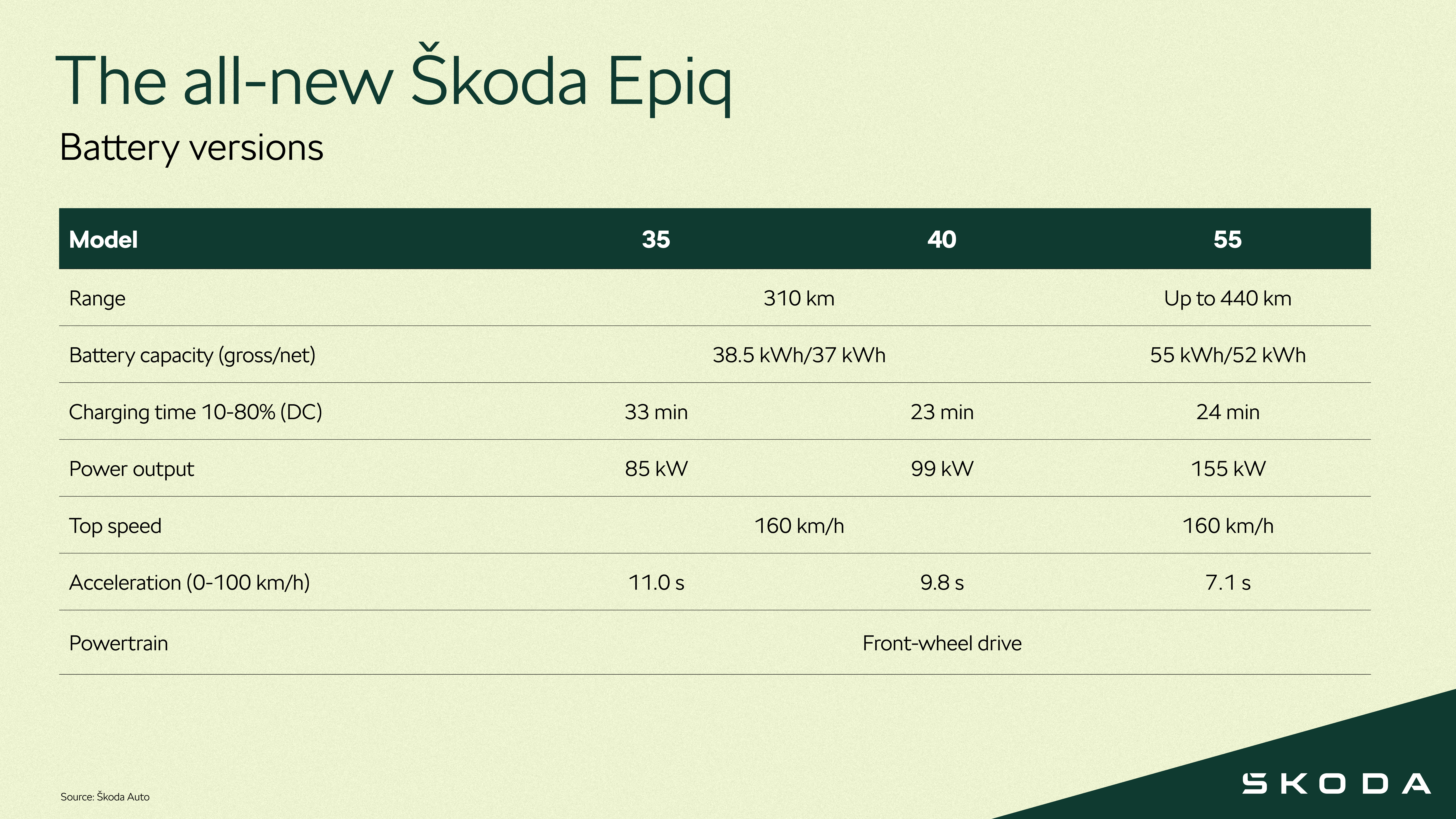
Mladá Boleslav, 14 September 2026 – The Epiq is Škoda’s first electric model built on the MEB+ platform with front-wheel drive. It uses smaller, lighter traction batteries, enabling lower energy consumption and more interior space. This SUV crossover is available with two traction battery capacities and three power variants, with outputs ranging from 85 kW to 155 kW , and a range of up to 440 kilometres. Using DC fast charging, the range-topping Epiq 55 can be charged from 10% to 80% in 24 minutes⁴.
In developing the Epiq, we harnessed the strengths of the new MEB+ platform to create an electric vehicle that is efficient, practical, and intuitive in everyday use. Smaller, lighter traction batteries contribute to lower energy consumption and generous interior space. A range of up to 440 kilometres, fast and bidirectional charging, and full one-pedal driving bring technologies familiar from higher segments to a compact vehicle.
Two traction battery options
The Epiq is available with two traction battery options: the smaller battery has a gross capacity of 38.5 kWh (37 kWh net) and uses lithium-iron-phosphate (LFP) chemistry. The larger battery offers a gross capacity of 55 kWh (52 kWh net) and uses nickel-manganese-cobalt (NMC) chemistry, providing higher energy density and enabling a longer driving range.
Three power variants
The Epiq is offered in three power variants: 35, 40, and 55. The Epiq 35 uses the smaller traction battery and delivers a maximum output of 85 kW⁵. The Epiq 40 uses the same battery but offers a maximum output of 99 kW⁵. Charging the Epiq 40 from 10% to 80% takes 23 minutes⁴. Both variants deliver a maximum torque of 267 Nm and offer a range of around 310 kilometres on a single charge.
The range-topping Epiq 55 is paired with the larger battery and delivers 155 kW⁵ to the front wheels, with a maximum torque of 290 Nm. This variant offers a range of up to 440 kilometres and fast DC charging from 10% to 80% in 24 minutes⁴.
All variants are powered by a highly efficient APP 290 permanent-magnet synchronous motor, which enables dynamic acceleration; their top speed is limited to 160 km/h. Regenerative braking, a coasting function, and an ECO assistant support efficient driving and optimise energy consumption.
First front-wheel-drive Škoda model on the MEB+ electric platform
The Epiq is the first Škoda based on the new MEB+ electric platform. Alongside the Epiq, three other Volkswagen Group models have also been introduced on this platform this year, strengthening the car manufacturer’s position in the competitive small BEV segment: the Volkswagen ID. Polo, Volkswagen ID. Cross, and Cupra Raval. The front-wheel-drive configuration distinguishes the Epiq from other Škoda BEV models. The platform architecture is designed for smaller, lighter traction batteries, contributing to lower energy consumption and efficient vehicle packaging.
Bidirectional charging
The Epiq features bidirectional charging. This allows energy stored in its battery to be used externally. Vehicle-to-Load (V2L) can power external devices, such as e-bikes or electrical appliances, via a V2L adapter connected to the vehicle’s charging port.
The Epiq also supports Vehicle-to-Home (V2H), which can use energy stored in the vehicle’s battery to power a household or business, helping to optimise energy consumption, for example by drawing on the battery during peak tariff periods and charging the vehicle when electricity is cheaper. V2H requires a compatible DC bidirectional wallbox; AmbiCHARGE Home 11 kW DC by Ambibox is currently certified for the Epiq.
Axles and brakes
Both axles of the new Epiq are fitted with disc brakes, with ventilated discs at the front. Because of the front-wheel-drive configuration, the rear axle does not use regenerative braking to slow the car down, resulting in more frequent use of the rear brakes and consequently reducing the oxidation of the discs. The front axle features a MacPherson layout with lower triangular wishbones and a transverse torsion stabiliser. At the rear, a proven trailing-arm axle with a torsion beam is used.
One-pedal driving
The new Epiq makes everyday driving even more convenient with its full one-pedal driving function in B mode. Once activated, the driver can control the vehicle using only the accelerator pedal: when it is released, the Epiq decelerates smoothly to a full stop while recuperating energy and feeding it back into the battery. The intensity of recuperation can also be adjusted to suit the driving situation and the driver’s preferences, bringing greater comfort, especially in urban traffic, slow-moving queues, or on long descents. This supports intuitive vehicle control, a calmer driving experience, and more efficient use of the electric powertrain.
⁴ Maximum charging power and Charging time (from 10% to 80%). The actual charging performance can vary between charging stations even at the same kW rating. It depends on factors such as maximum charging current, ambient and battery temperature, battery state of charge and ageing, as well as the condition and load of the charging station and infrastructure. The stated maximum power is measured under WLTP conditions at around 23 °C and a battery state of charge of at least five per cent. Changes in these conditions may lead to different charging performance.
⁵ The maximum power is determined in accordance with UN-GTR.21. The maximum power is available when the high-voltage battery is at its highest possible state of charge (SoC) and operating within its optimal temperature range. The power available varies according to the driving scenario and is influenced by factors including the battery’s temperature, SoC, and physical ageing.
 |
Explore the new ‘What’s up, Škoda?’ channel: go.skoda.eu/whatsapp |


Vítězslav Kodym
Head of Product Communications
+420 604 292 131
vitezslav.kodym@skoda-auto.cz
Jan Hrbek
Spokesperson Product Communications
+420 730 867 534
jan.hrbek@skoda-auto.cz