Turtle, window, fountain: Warning indicator lights you may not recognise

Turtle, window, fountain: Warning indicator lights you may not recognise

Warning indicator lights are an essential communication interface between a modern car and its driver. Many of them are widely recognised, but a number are rarely encountered in everyday driving. Nevertheless, drivers should not be caught off guard when they appear. Get to know them.

28. 4. 2026 Lifestyle

A simple pictogram is often worth a thousand words. That is why, even today, in the era of large digital displays, cars still use warning lights to alert drivers to certain conditions of the vehicle and its functions, indicatingwarnings or even malfunctions. The advantage of warning lights is that a whole range of them can fit on a relatively small instrument panel, so they can effectively inform the driver about several things at once. 

Many indicator lights are entirely “harmless” and purely informative. These are generally well known to drivers. Modern cars, particularly electric ones, however, are also equipped with a number of indicator lights that drivers do not commonly encounter. It is still important to understand them, as in some cases they can help clarify an uncertain situation, while in others they provide a critical warning. Storyboard has selected several indicator lights that should not come as a surprise to drivers: 

 
Bad weather lights activated

Drivers are generally familiar with the fog light indicator, and the rear fog light indicator is also present in Škoda electric cars. However, in modern Škoda cars, the icon for the front fog lights has been replaced by an indicator labelled “Bad weather lights activated”. Do not let this confuse you and use these lights correctly and in accordance with regulations. 

Snimek-obrazovky-2026-03-31-v-11.09.46_b60fd540

Snimek-obrazovky-2026-03-31-v-11.12.25_a669d7fb

Lights not switched on 

Modern Škoda vehicles are equipped with an advanced automatic lighting system that usually manages the operation of the lights without driver´s intervention. The illuminated indicators clearly show the driver which lights are currently active. If, for some reason, the automatic mode is not switched on (for example, if the driver previously deactivated it) and the car system determines that the lights should nevertheless be switched on, the driver is alerted by the “Lights not switched on” indicator. A similar indicator featuring an exclamation mark in the centre signals a fault in a bulb or lighting module. 

Increased CO₂ concentration 

The unusual indicator showing a window in a door signifies an increased concentration of CO₂ inside the car, indicating an unhealthy environment for passengers. In this situation, the vehicle system increases the fan speed (or activates it if the vehicle is parked with the ignition switched off), and the passengers should open the windows to ventilate the interior. In all cases, the vehicle must be taken to a service centre. 

Snimek-obrazovky-2026-03-31-v-11.14.45_476c5647

Snimek-obrazovky-2026-03-31-v-11.17.20_80bcc4e6

Worn brake pads 

In electric vehicles and hybrids, which primarily decelerate using regenerative braking, the vehicle electronics also monitor the condition of the brakes. The “Worn brake pads” indicator alerts the driver that the brake linings have reached their wear limit. The driver should proceed with increased caution and drive to a service centre without delay. 

Electric powertrain fault, regenerative braking fault and fire hazard 

While drivers have been familiar with the engine warning light for decades, the “Electric powertrain fault” indicator is new to most. When illuminated in amber, it indicates a fault that allows the driver to continue driving cautiously, but the vehicle must be taken to a service centre without delay. 

An amber light illuminated together with the ABS indicator signals a fault in the regenerative braking system. A red light indicates a serious fault, and driving must not be continued. 

A red light in combination with the coolant temperature indicator points to overheating of the electric system; in this case, driving must also be discontinued. 

If the icon illuminates red together with an exclamation mark, it indicates a fire hazard (the car horn may also sound). The car must be stopped immediately in a safe location, hazard warning lights switched on, all passengers must exit the vehicle and move to a safe distance, and the emergency services must be contacted. 

Power steering and steering lock malfunction 

A driver should immediately notice that something is wrong if the “Power steering malfunction” indicator illuminates. An amber light indicates a partial failure of the power steering system, resulting in reduced steering assistance. Switch the ignition off and on again and drive a few metres. If the amber indicator does not go out, driving may continue with caution, and the vehicle must be taken to a service centre. A red indicator signifies a complete failure, in which case driving must not be continued. 

A special case is a flashing indicator. If a message indicating a steering lock malfunction appears together with a flashing amber indicator, cautious driving is possible and the vehicle must be taken to a service centre. If the indicator flashes red, driving must not be continued. 

If a message instructing the driver to move the steering wheel appears together with a flashing amber indicator, the steering lock is not unlocked. Move the steering wheel alternately to both sides. If the steering does not unlock, driving must not be continued. 

Limited or insufficient driving performance  

One of the new indicator lights specific to electric cars is the so-called “turtle”, officially labelled “Limited or Insufficient driving performance”. It may illuminate in two situations. When illuminated in amber, it indicates that the battery is very cold and unable to deliver full performance, or that the battery charge level is low but not critical. In this case, the vehicle speed is limited, depending on conditions, to a maximum of 130 km/h. If the battery is cold, it should be warmed up through driving. If the charge level is low, the battery should be recharged. 

If the indicator illuminates red, it means that the battery has reached a minimum energy level or is extremely cold. The car may only be able to “crawl” at a speed of around 7 km/h, with a risk of stopping in traffic. If the battery is cold, connect the car to a charging station for approximately 10 minutes. If no charging station is available, warm the battery by driving for around 10 minutes. Then stop, switch the ignition off and on again. If the indicator remains illuminated, repeat the warming procedure. 

If the charge level is low and it is possible to safely reach a charging station, charge the battery. If not, park the car safely and seek assistance from a service center. 
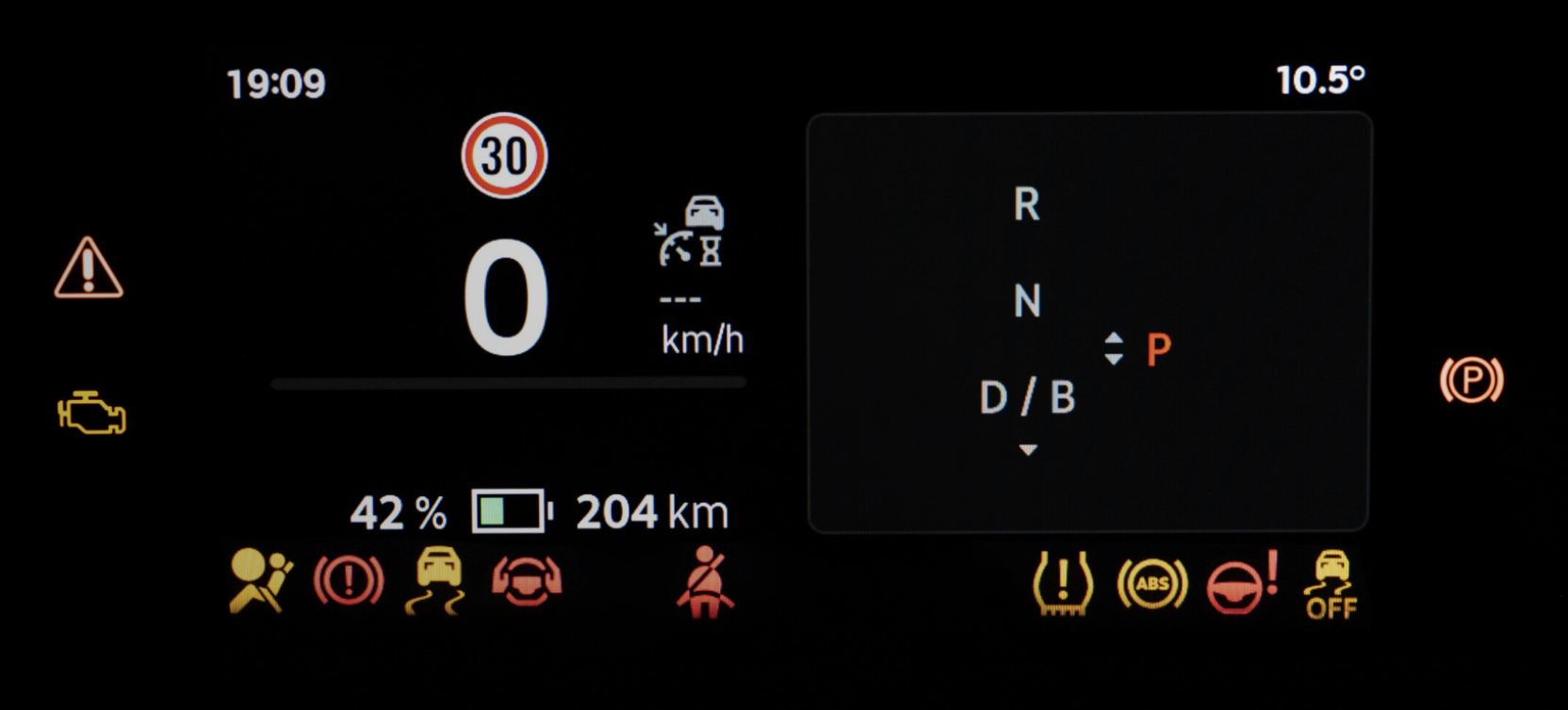
You can find the meanings of all the warning lights in your vehicle's owner's manual
Owner's manual

Electronic engine sound (e-Sound) malfunction  

The icon showing a vehicle with a loudspeaker on the roof indicates a fault in the electronic engine sound system. The driver should pay close attention in this case: the electronic sound serves as an audible warning for pedestrians, and if the indicator is illuminated, people in the vicinity of the vehicle may not be aware of its presence. Driving should therefore continue with increased caution, and a service centre should be visited as soon as possible. 

Snimek-obrazovky-2026-03-31-v-11.39.40_3b4f9e39

Snimek-obrazovky-2026-03-31-v-11.40.48_9f5cad19

Bonus: Low windscreen washer fluid level 

While most of the above warning lights belong to the category that drivers usually don't want to see, the "fountain" icon, which indicates a low windshield washer fluid level, should be their friend. The indicator light lets the driver know in good time that the washer fluid reservoir is running low – before it runs out, giving the driver enough time to stop at a gas station and top up the fluid. Škoda cars have had this clever feature since the late 1990s. This means that the fluid will not run out without warning, and driving in bad weather does not have to become a gamble. All it takes is paying attention to the indicator.